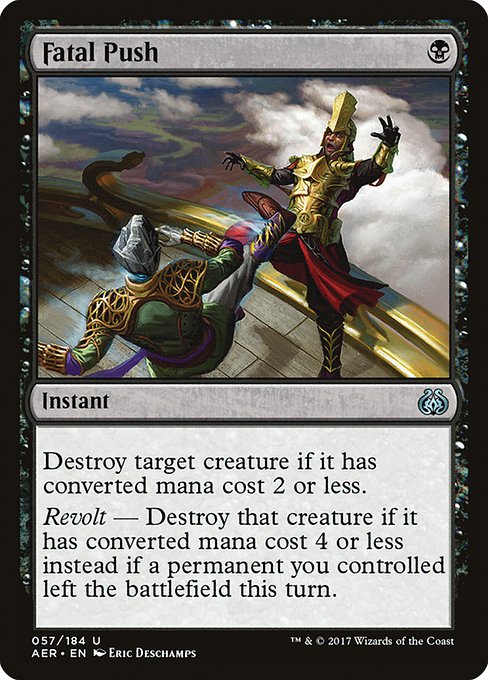
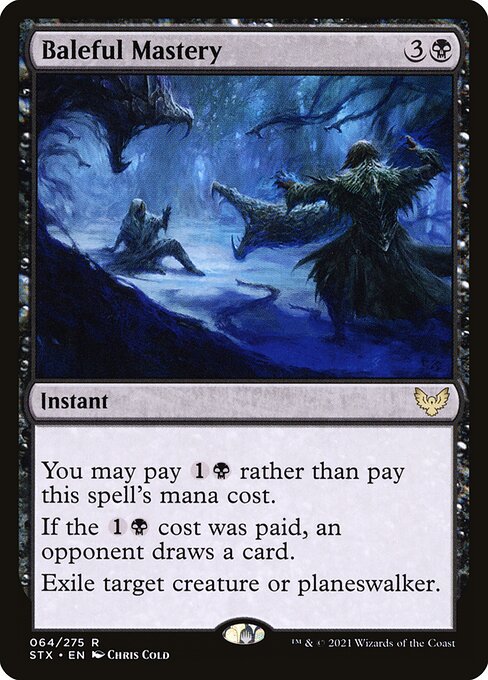
<?xml version="1.0" encoding="utf-8"?><feed xmlns="http://www.w3.org/2005/Atom" ><generator uri="https://jekyllrb.com/" version="3.10.0">Jekyll</generator><link href="https://cirion02.github.io/cirion-blog/feed.xml" rel="self" type="application/atom+xml" /><link href="https://cirion02.github.io/cirion-blog/" rel="alternate" type="text/html" /><updated>2026-05-23T19:26:02+00:00</updated><id>https://cirion02.github.io/cirion-blog/feed.xml</id><title type="html">Cirion’s Ramble Palace</title><subtitle>Cirion&apos;s blog site for random topics.</subtitle><entry><title type="html">Is the New Arena Draft Mode Worth It?</title><link href="https://cirion02.github.io/cirion-blog/2026/05/23/Is-the-New-Arena-Draft-Mode-Worth-It.html" rel="alternate" type="text/html" title="Is the New Arena Draft Mode Worth It?" /><published>2026-05-23T08:19:00+00:00</published><updated>2026-05-23T08:19:00+00:00</updated><id>https://cirion02.github.io/cirion-blog/2026/05/23/Is-the-New-Arena-Draft-Mode-Worth-It</id><content type="html" xml:base="https://cirion02.github.io/cirion-blog/2026/05/23/Is-the-New-Arena-Draft-Mode-Worth-It.html"><![CDATA[<p>In the latest arena announcement, Wizards unveiled a new draft mode, “Contender Draft”. This costs more to enter, but has higher rewards for doing well. In this article I’ll be evaluating if it is worth it to play that mode instead of Premier Draft.</p>

<p>For the methodology of this article, I will be assuming you enter drafts by paying gems, and that booster packs do not matter to you, as that seems to be the consensus among strong drafters I know.</p>

<p>Let’s start with the reward table for both events (adjusted for their different entry costs.)</p>

<table>
  <thead>
    <tr>
      <th> </th>
      <th>0-3</th>
      <th>1-3</th>
      <th>2-3</th>
      <th>3-3</th>
      <th>4-3</th>
      <th>5-3</th>
      <th>6-3</th>
      <th>7-X*</th>
    </tr>
  </thead>
  <tbody>
    <tr>
      <td>Premier Draft</td>
      <td>-1450</td>
      <td>-1400</td>
      <td>-1250</td>
      <td>-500</td>
      <td>-100</td>
      <td>+100</td>
      <td>+300</td>
      <td>+700</td>
    </tr>
    <tr>
      <td>Contender Draft</td>
      <td>-3000</td>
      <td>-3000</td>
      <td>-3000</td>
      <td>-1600</td>
      <td>-200</td>
      <td>+200</td>
      <td>+1200</td>
      <td>+4200</td>
    </tr>
  </tbody>
</table>

<p>*Note that 7-0, 7-1 &amp; 7-2 all pay the same in both modes.</p>

<p>From this chart we can see a couple of things. It is a lot easier to offset bad results with good ones in contender draft, as a 7-X pays for almost 1.5 0-3’s. Whereas in premier it pays for less than half. premier draft does make an even 3-3 record sting a lot less. The numbers in contender are also obviously bigger, which makes it likely that anyone with a low winrate should stay away from contender draft. But let’s get into the hard math.</p>

<p>I will be performing the math in two ways, in the theoretical world, where I just calculate the EV for any given winrate. (This assumes your winrate is the same at 0-2 as it is at 6-0, which might be untrue, since your decks are obviously different power levels, but I expect the opponents decks to broadly cancel out that effect.) Secondly I will be testing it directly again a sample of ~250 drafts from one of my friends, who is an excellent drafter.</p>

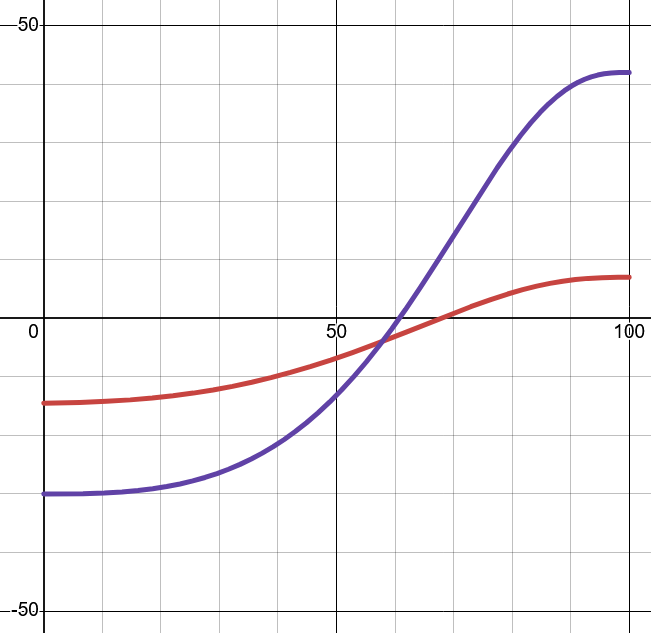
<p>First, the winrate data, the graph looks like this, the X-axis being your winrate in %, and the Y-axis being your expected gems divided by 100. (This is done to make the graph look nicer.)
<img src="/cirion-blog//assets/img/DraftRewardGraph.png" alt="Graph of winrate vs reward" /></p>

<p>The red line is for premier draft, the Purple line is for contender draft.</p>

<p>From this we can see that contender breaks even much faster, and is better than premier even before that. The exact breakpoint is that contender has a higher return is at 57.86% winrate. Contender breaks even at 60.7% winrate, while premier only breaks even at a 67.8% winrate. So from these metrics all strong drafters should shift over.</p>

<p>Now let’s compare our real world data. My friend has an overall record of 1189-662 over the course of 266 drafts.[^1] That means a 64.2% winrate. The formula above expects him to have lost an average of 145 gems per draft, he actually averaged losing 119, which is better but close to the expected value, so the math is probably reasonably accurate. However if he had been earning the rewards of contender draft, he would’ve earned 565 gems per draft on average. That’s a total of 182k gems lost, which would cost over 900 dollars to buy.</p>

<p>Overall, contender draft is rewarded excellently, but there is one final hurdle. The average player in a contender draft is probably better at the game. This can be accounted for by modeling the player’s winrate as going down in contender vs premier. Modeling this as a 3% drop moves the crossover point to a 62.1% (premier) winrate. However the exact numbers here are hard to guess as there is no data to work with. Overall I do expect strong drafters will probably make more gems in this new gamemode.</p>]]></content><author><name></name></author><category term="mtg" /><category term="math" /><category term="retail-limited" /><summary type="html"><![CDATA[In the latest arena announcement, Wizards unveiled a new draft mode, “Contender Draft”. This costs more to enter, but has higher rewards for doing well. In this article I’ll be evaluating if it is worth it to play that mode instead of Premier Draft.]]></summary></entry><entry><title type="html">I Watched Wavelength</title><link href="https://cirion02.github.io/cirion-blog/2026/04/24/I-Watched-Wavelength.html" rel="alternate" type="text/html" title="I Watched Wavelength" /><published>2026-04-24T06:45:00+00:00</published><updated>2026-04-24T06:45:00+00:00</updated><id>https://cirion02.github.io/cirion-blog/2026/04/24/I-Watched-Wavelength</id><content type="html" xml:base="https://cirion02.github.io/cirion-blog/2026/04/24/I-Watched-Wavelength.html"><![CDATA[<p>Watching paint dry is an exercise in patience, watching Wavelength is an exercise in convincing yourself you are doing something more meaningful.</p>

<p>Wavelength is a 1967 experimental art film where you spend 45 minutes looking at a room. Roughly 3 events happen in said 45 minutes, and their importance to anything is questionable. As a film it dares you to get bored watching it, I instead, was fascinated. If you wish to watch Wavelength you can do so here <a href="https://archive.org/details/wavelength-michael-snow-1967">Wavelength (on archive.org)</a>.</p>

<p>This is not a review of the movie, reviewing it to me is missing the point. This is a retelling of my experience watching the film. Tainted by only containing what I remember, as I took no notes while watching. To me, the point of this movie is what goes on in the viewer’s mind while watching it. As such, I explain what went on in mine. This will include discussing the movie only in so far as I was thinking about the movie while watching it.</p>

<p>To start the movie, I was aware this was going to be boring, or at least boring if you don’t know how to entertain yourself. As such, my first experience was to do what I always do when bored, look around the room. I observed the chairs, desk, the closet and tried to make out what was outside the window. This was complicated by the awkward lighting and frequent color changing, this was the first thing I spent time thinking about. I was unsure if it was maybe just an artifact of the time, but I didn’t believe it was, so why do the colors and lighting change so much? I never really found a satisfying answer, this bothered me slightly.</p>

<p>After this I was mostly thinking about why I was watching and what I was gaining from it. Why I decided to do it in the first place, and then something happened in the movie. Two women walked in and interrupted my thought process, which felt very strange, as by all means I’d been alone with my thoughts for some time. Now my brain was just fully focused on the movie and what was happening. In practice, nothing was, they sat down, turned on the radio for a few minutes, then left. But it did engage me the whole time, which is so intriguing. By sheer lack of stimulation even a normally very boring scene can be made to engage.</p>

<p>After that scene had come and gone, I started thinking about the experience of watching, mostly noticing I was not getting distracted, which surprised me. My mind was wandering, but almost all thoughts were still about Wavelength in some way. I had thoughts about whether we are expected to imagine a story happening somewhere off-screen. About whether the cameraperson was essentially having the same experience as I was. How someone who is not like me might experience this movie. This is also when the quote at the start of the post popped into my mind and stuck there. Because I could not fully decide whether I think watching Wavelength is more meaningful than watching paint dry. Is there existing an artistic—</p>

<p>A guy stumbles into the room, falls to the floor, seemingly dead. The camera doesn’t move, he is mostly off-screen but his jacket is visible—</p>

<p>I tried to capture the being snapped out of your train of thought by that moment in text. This was the most exciting thing that did so, although my intrigue about the film is that any noticeable change caused the same effect, the camera’s white-balancing changing so I could see outside slightly better also snapped me out in the same way.</p>

<p>The body itself is addressed later in the last of what I would call the 3 “events”, but ultimately I didn’t think that much about the guy, I wondered why he was added from an artistic perspective. Maybe it lends credence to the theory that you are meant to imagine a story happening outside the view of the camera. Maybe it is just meant to get less engaged viewers to pay attention again. As with most things in this movie, I don’t have a satisfying conclusion, only a thought process I found engaging.</p>

<p>After the last scene I was starting to get somewhat bored, which led me to once again consider why I was watching. Was I trying to prove my attention span wasn’t short, not really, but it’s a fun hypothesis my brain came up with. Would this be artistically less valuable of an experience if I stopped here and didn’t finish it? That question ended up getting an answer in my head of yes, after having led me back to thinking about watching paint dry. The existence of artistic intent in Wavelength helped my brain fill in the gaps between self-reflection in a way that organically kept me focused, which I don’t think would be possible for a purely patience-based exercise.</p>

<p>The last thing that popped in my head and I spent time considering was: If the artistic intent of the movie was counter to my experience, would it be less meaningful? The way I made that more concrete in my head was imagining “Wavelength but it ends with a jumpscare”. This would radically alter the tone of the movie, as the boredom is no longer self-justifying but meant to lull the audience into a sense of security, and yet, I think the boredom would be equally meaningful to me. As I would’ve had the same experience until the end. The jumpscare would’ve reframed the experience, but not undermined it.</p>

<p>Roughly here in my thought process, the movie ended. My thought process involved a lot of questions and few answers, but I don’t really mind that. Answers don’t make something interesting, questions you can keep pondering do.</p>

<p>I will say not every meaningful thought I had is present in this article, for example, I thought a lot about writing this article while watching. But I think it captures the experience reasonably well. If you wish to watch Wavelength after reading this, I am interested to hear your thoughts on it.</p>]]></content><author><name></name></author><category term="movies" /><category term="art" /><category term="philosophy" /><summary type="html"><![CDATA[Watching paint dry is an exercise in patience, watching Wavelength is an exercise in convincing yourself you are doing something more meaningful.]]></summary></entry><entry><title type="html">Rendering Perfectionism 1: Order of the Vector</title><link href="https://cirion02.github.io/cirion-blog/2025/12/18/Rendering-Perfectionism-1-Order-of-the-Vector.html" rel="alternate" type="text/html" title="Rendering Perfectionism 1: Order of the Vector" /><published>2025-12-18T08:42:02+00:00</published><updated>2025-12-18T08:42:02+00:00</updated><id>https://cirion02.github.io/cirion-blog/2025/12/18/Rendering-Perfectionism-1-Order-of-the-Vector</id><content type="html" xml:base="https://cirion02.github.io/cirion-blog/2025/12/18/Rendering-Perfectionism-1-Order-of-the-Vector.html"><![CDATA[<p>Since this is the first port of this series, a quick primer. I maintain a cube called Trolley Problem Cube, the specifics of this cube are not relevant here. The important part is that I often need to make images (or so to say, renders) of cards in the cube that are not real or for some reason need a render different from their official render. (For example, some un-cards need added reminder text.)</p>

<p>This process is usually quite smooth and not that hard, however I am very perfectionistic when it comes to these renders. This often leads me to spend way too much time on small tasks that probably 0-1 people will ever notice. This series will be talking about such processes, simply because I want to talk about them.</p>

<p>For the first post I’ll immediately give an example of my going way too far, because it’s not even covering a card. I just needed the Order of the Widget watermark for a small flare on one of the cards. Now a normal person would’ve just taken it from a random contraption and been done with that, which is what I should have done. It is not what I did. I decided to make a fully vectorized version of the watermark.</p>

<p><img src="/cirion-blog//assets/img/Order of the Widget.png" alt="Pixelated version vs Vector version" /></p>

<p>Above you can see the two versions next to each other. The quality gap is really visible here, but on the card size you probably won’t notice it. One advantage of having done this is that I now have this for future projects. I think it’s unlikely I will need this again, but it’s possible.</p>

<p>Now just looking at the final result probably doesn’t quite capture how much effort went into making this. So below I include a version of the icon with each individual vector object colored, so you can see every shape I placed.</p>

<p><img src="/cirion-blog//assets/img/Order of the Widget Colored.png" alt="Colored Vector version" /></p>

<p>I wanted the icon to scale to any resolution perfectly, so all of the negatives have to be done in vector space too, which took a while. Especially since I’m not all that experienced working with vectors. But I did enjoy the process, and the end product is very satisfying to look at. Which means I’ll probably spend this much effort on something small again and write more articles about doing it. :)</p>

<p>Also, if you want to download the SVG so you can use this yourself, here is the link:
<a href="/cirion-blog//assets/other/Order of the Widget.svg">Order of the Widget Vector</a></p>]]></content><author><name></name></author><category term="mtg" /><category term="rendering" /><category term="trolley-cube" /><summary type="html"><![CDATA[Since this is the first port of this series, a quick primer. I maintain a cube called Trolley Problem Cube, the specifics of this cube are not relevant here. The important part is that I often need to make images (or so to say, renders) of cards in the cube that are not real or for some reason need a render different from their official render. (For example, some un-cards need added reminder text.)]]></summary></entry><entry><title type="html">Fair Consulation in Canlander</title><link href="https://cirion02.github.io/cirion-blog/2025/12/02/Fair-Consulation-in-Canlander.html" rel="alternate" type="text/html" title="Fair Consulation in Canlander" /><published>2025-12-02T16:46:06+00:00</published><updated>2025-12-02T16:46:06+00:00</updated><id>https://cirion02.github.io/cirion-blog/2025/12/02/Fair-Consulation-in-Canlander</id><content type="html" xml:base="https://cirion02.github.io/cirion-blog/2025/12/02/Fair-Consulation-in-Canlander.html"><![CDATA[<p>I’ve been thinking about the canlander points list lately, mostly in regard to the tutors. Most of the good ones are pointed, (ie: everything down to <a href="https://scryfall.com/card/fdn/617/wishclaw-talisman">Wishclaw</a> &amp; <a href="https://scryfall.com/card/sta/33/tainted-pact">Tainted Pact</a>) but one notable one isn’t, Demonic Consultation.
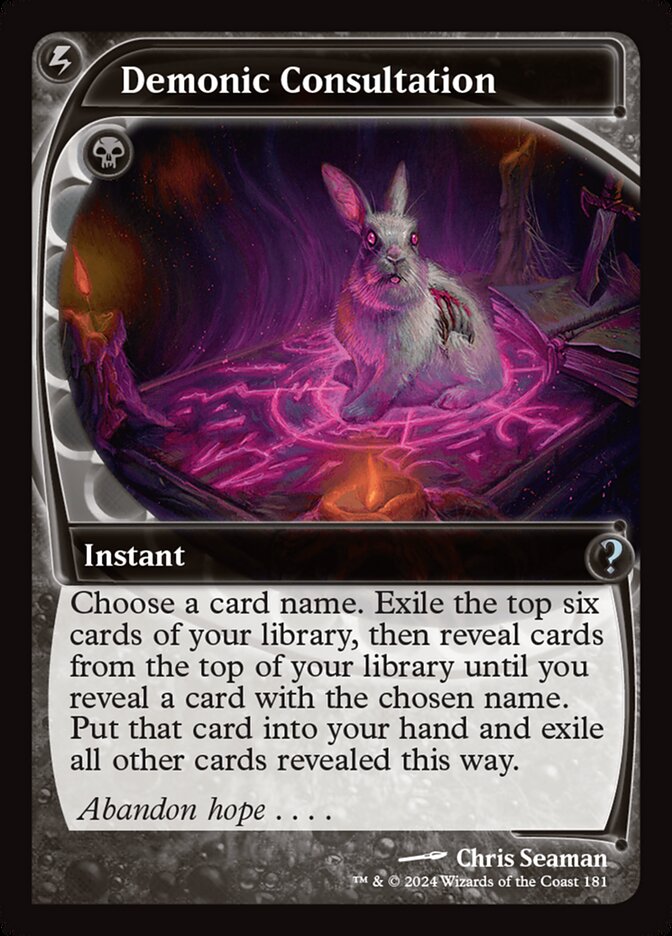
<img src="https://cards.scryfall.io/large/front/8/d/8dd7eac8-d6df-48b2-8e64-bdf198c53264.jpg" alt="Demonic Consultation" /></p>

<p>Now I understand why this is, it’s mostly seen as a combo piece with <a href="https://scryfall.com/card/thb/73/thassas-oracle">Thassa’s Oracle</a>, which is pointed highly. But is that really the only way to use a 1 mana instant speed tutor? Consultation has been banned in legacy and restricted in vintage since 2000, way before <a href="https://scryfall.com/card/isd/61/laboratory-maniac">Lab Man</a> came out in 2011. So the card itself must be good, even when it doesn’t just say “Exile your library”.</p>

<p>You might be saying, “of course it’s good there, those aren’t singleton formats” and that’s a very valid point. Playing Consultation fairly in canlander has a ~9% chance of killing you instantly. Which is… bad. But is it that bad? I can think of plenty of times when tutoring the exact card I need swings my win probability by way more than 9%. If there’s a combo on the stack, I’m happy to lose 9% of the time to get a <a href="https://scryfall.com/card/dmr/50/force-of-will">Force of Will</a> the other times. Same the other way around, if I’m tutoring up a combo that wins me the game instantly, I’ll take 9% to lose if I win the other times.</p>

<p>What I’m getting at is, Consultation is a good tutor in high leverage situations, aka in situations where the game ends very soon. If the card you’re getting changes your win probability by more than 9%, then consultation is good<sup id="fnref:1" role="doc-noteref"><a href="#fn:1" class="footnote" rel="footnote">1</a></sup>, and combo decks are all about taking calculated risks.</p>

<p>Now the main issue is the card is dead if you’re not in those situations, which is a real downside, but I do believe it is worth playing in combo decks because of its immense efficiency in the good situations.</p>

<p>That was the main body of this post, but I have some idle thoughts I want to add:</p>
<ul>
  <li>You can significantly reduce the chance of dying if you have some knowledge of your deck, through effects like <a href="https://scryfall.com/card/dsc/113/brainstorm">Brainstorm</a> and <a href="https://scryfall.com/card/tdc/159/ponder">Ponder</a>.</li>
  <li>The 9% chance is based on having 85 cards in your library, and the top 6 and bottom 2 cards of the deck being losing hits, leading to a 9.4% chance of death, actual percentages change a lot depending on context.</li>
  <li>Having taken a mulligan without fetching after also lowers the chance of losing slightly, as the bottom card of your deck is now never the card you’re looking for.</li>
  <li>If the game ends up lasting longer than a turn or two, you have to work with a more than 9% lose chance, as more cards on the bottom of your decks become losing hits.</li>
</ul>

<div class="footnotes" role="doc-endnotes">
  <ol>
    <li id="fn:1" role="doc-endnote">
      <p>Technically this is wrong, the actual probabilities end up being multiplicative rather than the additive system mentioned here, but calculating win probability is abstract enough I think the simplicity is warranted. (It should actually improve your win probability by 9% of the current win probability, so 1% -&gt; 2% is still good enough.) <a href="#fnref:1" class="reversefootnote" role="doc-backlink">&#8617;</a></p>
    </li>
  </ol>
</div>]]></content><author><name></name></author><category term="mtg" /><category term="canlander" /><summary type="html"><![CDATA[I’ve been thinking about the canlander points list lately, mostly in regard to the tutors. Most of the good ones are pointed, (ie: everything down to Wishclaw &amp; Tainted Pact) but one notable one isn’t, Demonic Consultation.]]></summary></entry><entry><title type="html">Pai Gowermaxed 1: Initial Speculations</title><link href="https://cirion02.github.io/cirion-blog/2025/11/05/Pai-Gowermaxed-1-Initial-Speculations.html" rel="alternate" type="text/html" title="Pai Gowermaxed 1: Initial Speculations" /><published>2025-11-05T10:53:06+00:00</published><updated>2025-11-05T10:53:06+00:00</updated><id>https://cirion02.github.io/cirion-blog/2025/11/05/Pai-Gowermaxed-1-Initial-Speculations</id><content type="html" xml:base="https://cirion02.github.io/cirion-blog/2025/11/05/Pai-Gowermaxed-1-Initial-Speculations.html"><![CDATA[<p>This is the start of a minor sideprojects I was inspired to think about by some friends on discord. A Pai Gow cube that is entirely focused on maximizing its powerlevel.</p>

<p>But first, what is Pai Gow Magic? It is a format based on Pai Gow Poker, where two players are given a single pack each (or just 15 random cards here) and tasked to group them into 5 decks of 3 cards. Then players play five 1v1 matches with the decks in some random order. A couple special rules apply:</p>
<ul>
  <li>You start with all 3 cards in your hand.</li>
  <li>You don’t lose due to having an empty library.</li>
  <li>Your starting life total is 5.</li>
  <li>You have infinite mana of any type.</li>
</ul>

<p>Now that the format is explained, a quick word on my rules for the cube itself.</p>
<ul>
  <li>“Powermaxing” will be restricted to cards that are legal in vintage.</li>
  <li>The cube will be singleton.</li>
  <li>The cube will consist of 150 cards, this lets players play a best-of-5 match with the entire cube.</li>
</ul>

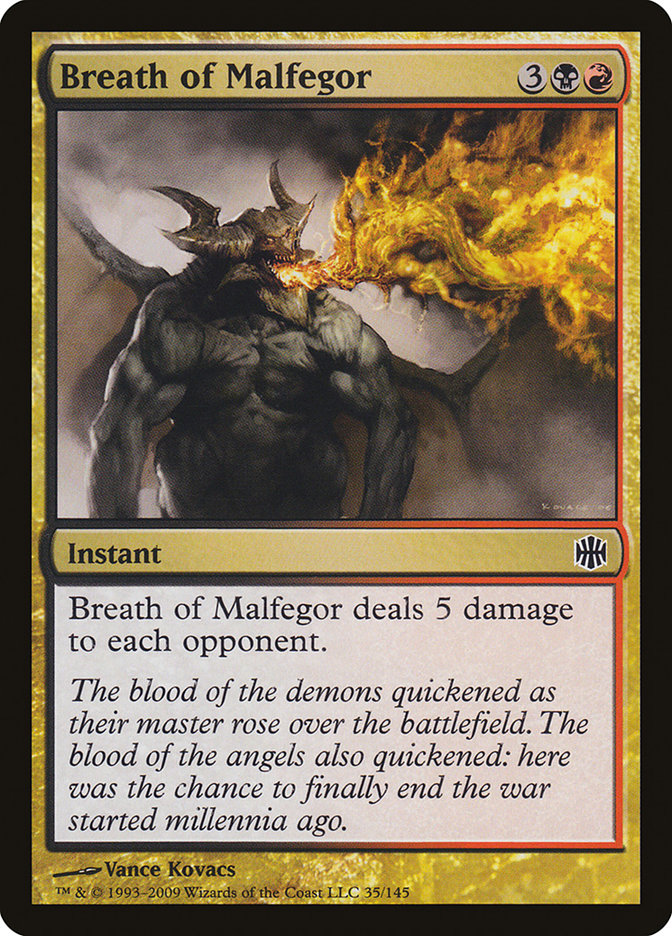
<p>Ok let’s start by considering the level 1 optimal strategy. Kill the opponent at instant speed on turn 1. This is easiest to do by simply dealing 5 damage to them, for example using Breath of Malfegor. (Full list I’ve found <a href="https://moxfield.com/decks/ZvHRLGy5sEiePgKHCwh5MQ">here</a>, note, these are only the unconditional ones.<sup id="fnref:1" role="doc-noteref"><a href="#fn:1" class="footnote" rel="footnote">1</a></sup>)
<img src="https://cards.scryfall.io/large/front/7/a/7a12e4d0-8471-46ac-85e4-a2ea5be8bf8f.jpg?1562642287" alt="Breath of Malfegor" /></p>

<p>Well, we’ve won on turn 1, what now? We now need to figure out how to beat this strategy. I see many ways to do this:</p>
<ul>
  <li>Gain enough life to be out of reach</li>
  <li>Prevent the damage</li>
  <li>Counter the spell</li>
  <li>Just win in response</li>
</ul>

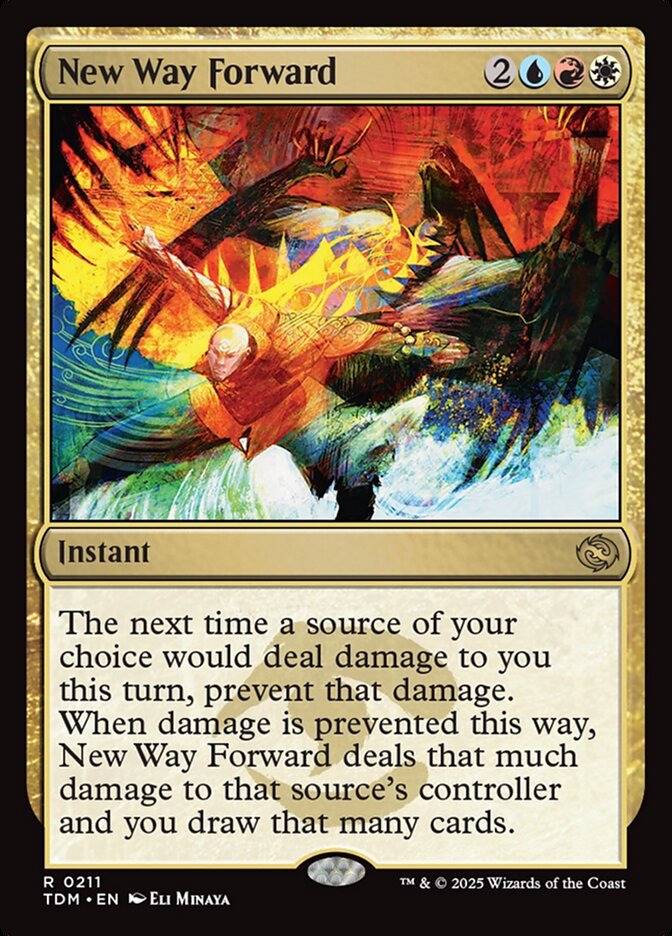
<p>The last option here just requires having the same level 1 cards as the opponent, but the other three all require unique cards, which all also have their own level 3 counters. These level 2 spells have an advantage over level 1 spells in that they both stop a level 1 and present a threat themselves, for example: New Way Forward.
<img src="https://cards.scryfall.io/large/front/d/9/d9d48f9e-79f0-478c-9db0-ff7ac4a8f401.jpg?1743204834" alt="New Way Forward" /></p>

<p>This card both stops a damage-based win attempt and also presents its own win condition. Most answers of this group still lose to some specific level 1 wins, as they specifically exclude their angle of interactions. (Some say damage can’t be prevented, or that they can’t be countered.)</p>

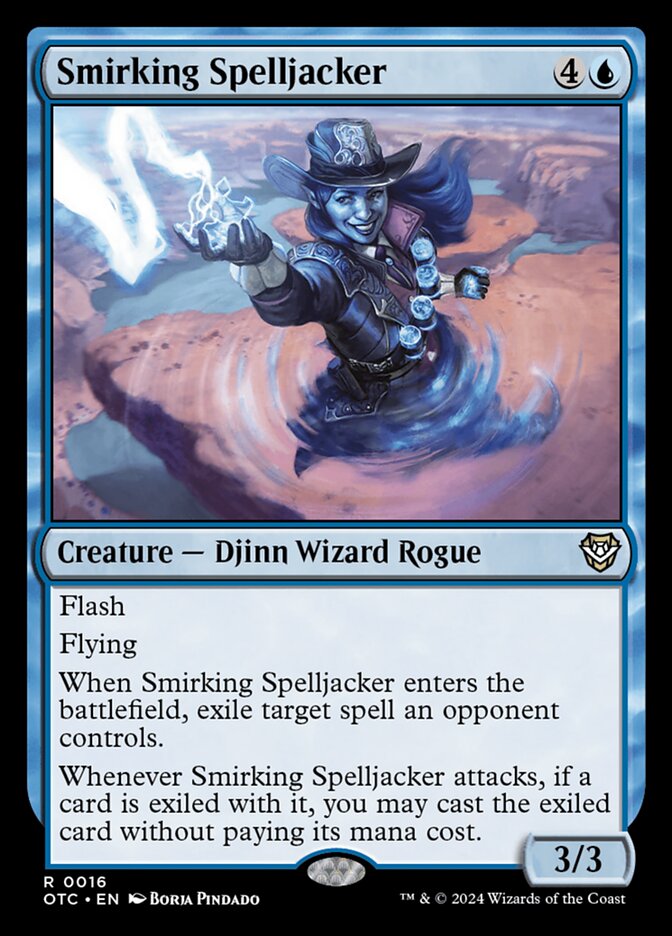
<p>What I expect to be the strongest set of level 2 cards are the counterspells. If you just add the cards mentioned above to a cube, I expect Smirking Spelljacker to be the strongest card is the cube.
<img src="https://cards.scryfall.io/large/front/0/1/01d1e394-1b0c-4b40-ba85-f55973703d41.jpg?1712353792" alt="Smirking Spelljacker" />
It gets around “can’t be countered” and presents a threat that can win on its own if not stopped. So the level 3 question becomes, how do I beat counterspells? Well, just win without casting a spell. The main ways to do this are manlands and other lands that slowly win the game. (Full list I’ve found <a href="https://moxfield.com/decks/kmQkO33X5UKKUg1egkasVw">here</a>)</p>
<p>I think adding specific counters to manlands is probably not worthwhile, as they are weak to the level 1 strategies. So in the end you get a complex version of rock, paper, scissors, where you throw three signs and also all signs have 50 variants.</p>

<p>I’ll be interested in seeing how this format will play out in actual testing, but that’ll have to wait until I have the time to assemble a list instead of just speculating. I expect it to broadly match up with my speculation here, although some cards not mentioned here may be so strong they warp the format in unexpected ways.</p>

<p>One final worry: I have a suspicion the optimal strategy for this format will end up being to play chicken with your opponent, because if both players have 3 “I win” cards, whoever plays one first loses. If this ends up being an issue, I’d suggest a rule that makes it so the starting player is forced to make the first move. Although the exact wording of that rule may be hard to make work.</p>

<p>Overall this is an interesting exercise and I’ll probably work on it further.</p>

<div class="footnotes" role="doc-endnotes">
  <ol>
    <li id="fn:1" role="doc-endnote">
      <p>For example, <a href="https://scryfall.com/card/ktk/189/mindswipe">Mindswipe</a> requires there to be a spell on the stack to work. <a href="#fnref:1" class="reversefootnote" role="doc-backlink">&#8617;</a></p>
    </li>
  </ol>
</div>]]></content><author><name></name></author><category term="mtg" /><category term="cube" /><category term="pai-gow" /><summary type="html"><![CDATA[This is the start of a minor sideprojects I was inspired to think about by some friends on discord. A Pai Gow cube that is entirely focused on maximizing its powerlevel.]]></summary></entry><entry><title type="html">The Problem with Binomial Distributions in Magic</title><link href="https://cirion02.github.io/cirion-blog/2025/10/04/The-Problem-with-Binomial-Distributions-in-Magic.html" rel="alternate" type="text/html" title="The Problem with Binomial Distributions in Magic" /><published>2025-10-04T11:07:00+00:00</published><updated>2025-10-04T11:07:00+00:00</updated><id>https://cirion02.github.io/cirion-blog/2025/10/04/The-Problem-with-Binomial-Distributions-in-Magic</id><content type="html" xml:base="https://cirion02.github.io/cirion-blog/2025/10/04/The-Problem-with-Binomial-Distributions-in-Magic.html"><![CDATA[<p>I’ve used, and have seen many others use Binomial Distribution calculators when designing magic decks, primarily for calculating how likely you are to draw a certain amount of lands. But while working on a future post involving land probability, I looked at that critically, and it’s just not correct.</p>

<p>First things first, what are binomial distribution calculators. A binomial distribution calculator is used to calculate the odds of a certain amount of events with a given probability happening if you try some amount of times. (Here’s a site I’ve seen used <a href="https://stattrek.com/online-calculator/binomial">Online Binomial Calculator</a>.) So for example, if I flip a coin 5 times, what’s the chance I hit heads 3 times.</p>

<p>The math for these is mildly complex, the formula is:
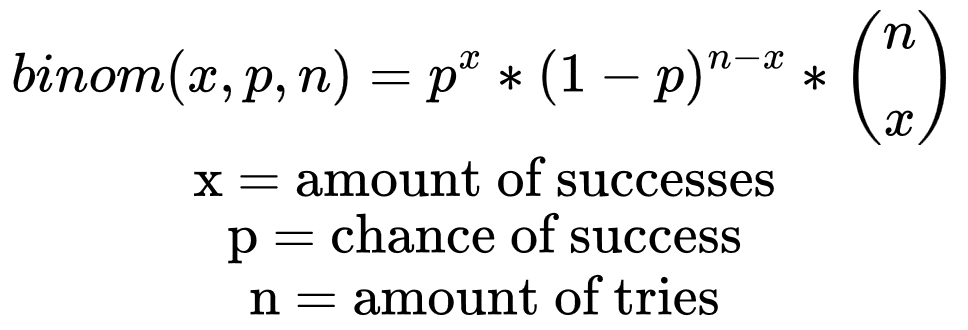
<img src="/cirion-blog//assets/img/BinomFormula.png" alt="Binomial Formula" />
The <code class="language-plaintext highlighter-rouge">n above x</code> is a function in probability theory which represents n choose x, which means: how many ways can you pick n different items out of a list of r. The total function is, chance of succeeding the correct amount of times, chance of failing the correct amount of times, and then accounting for those happening in some arbitrary order<sup id="fnref:1" role="doc-noteref"><a href="#fn:1" class="footnote" rel="footnote">1</a></sup></p>

<p>Ok, so what’s the problem, well, it’s the <code class="language-plaintext highlighter-rouge">p</code>, this formula assumes that the chance of succeeding does not change, or in math terms, the trials are independent. This is not true in magic, if you draw a land, there are now fewer lands in your deck, and thus the chance of drawing another land decrease. Binomial calculators do not account for this.</p>

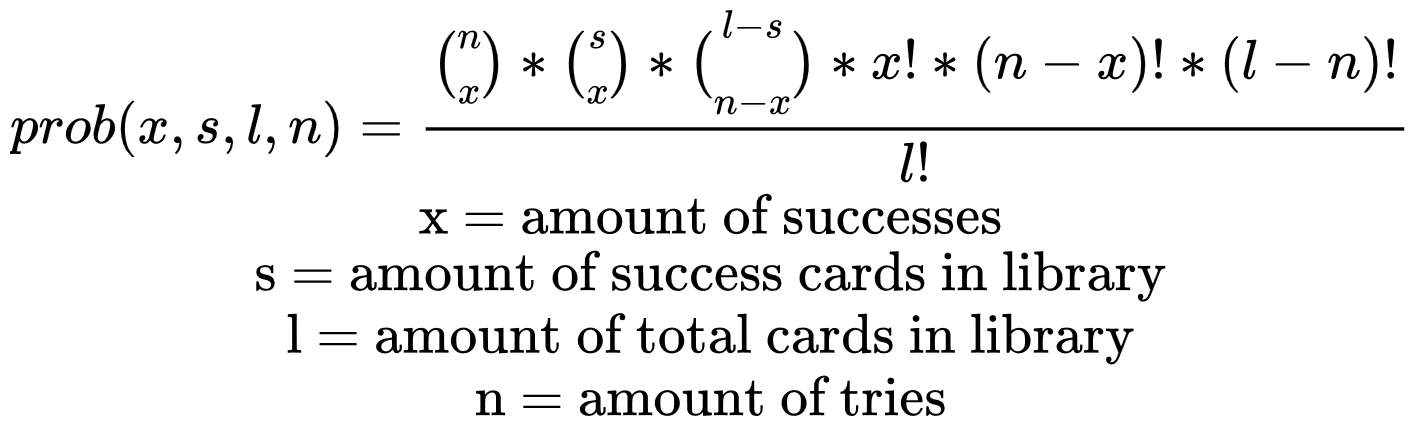
<p>So, what’s the solution? Well, it is very much possible to properly model the fact that drawing lands makes drawing lands less likely, here it is:
<img src="/cirion-blog//assets/img/CorrectLandsFormula.png" alt="Corrected Formula" />
Let’s go over this in parts, overall the idea here is to see how many ways there are to arrange the library that contain x lands in the top n cards. To do this we end up dividing by the total possible ways to arrange a library, which is <code class="language-plaintext highlighter-rouge">l!</code>. All the <code class="language-plaintext highlighter-rouge">a choose b</code> parts in some way represent the possible ways to draw the hand, they go as follows.  <code class="language-plaintext highlighter-rouge">n choose x</code> represents which cards in the hand end up being lands. <code class="language-plaintext highlighter-rouge">s choose x</code> represents which lands will be in the hand. <code class="language-plaintext highlighter-rouge">l-s choose n-x</code> represents which non-lands will be in our hand. Then to the factorials, these represent the order of all of our groups of cards. <code class="language-plaintext highlighter-rouge">x!</code> represents the order of the lands in our hand. <code class="language-plaintext highlighter-rouge">(n-x)!</code> represents the order of the non-lands in our hand. <code class="language-plaintext highlighter-rouge">(l-n)!</code> represents the order of all the cards left in our library we didn’t draw.</p>
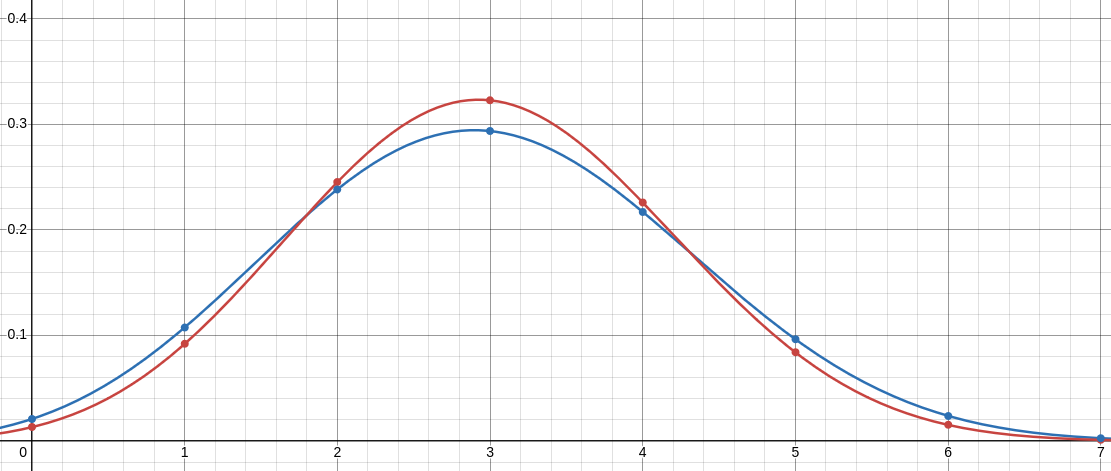
<p>Well that’s a lot more complex, does the difference even matter? The answer is: somewhat. It matters more in lower deck size formats like limited than in commander, but in either case the binomial formula makes extreme outcomes (&lt;1 or &gt;5 lands) look more likely then they are, and median outcomes (2-4 lands) less likely than they are. In 40 cards, with 17 lands, the difference is about 9% in total. With 3 land hands having the largest error, binomial gives them a 29.4% chance, while the true chance is 32.3%. Here is a graph of the two formula, the red line is mine, the blue line is a standard binomial curve.
<img src="/cirion-blog//assets/img/DraftBinomError.png" alt="Draft Compare" /></p>

<p>In commander this matters much less, but this formula is still more correct, the binomial curve has about a 3.4% error rate for drawing 7 cards out of a 99 card library with 37 lands. This mistake will go up as you draw more cards, so if you’re looking for the chance you draw something by turn 7 or so, it will matter a lot more.</p>

<p>Now, this is nice and all, but calculating this formula every time compared to just using a website for a 9% error rate is probably not worth it. That’s why I will now provide a calculator you can use, right at the end of this post. :)</p>

<script>

  //shamelessly stolen from geeksforgeeks
  function nCr(n, r){
    let sum = 1;

    for(let i = 1; i <= r; i++){
      sum = sum * (n - r + i) / i;
    }
    
    return Math.floor(sum);
  }

  function fact(n) {
    let res = 1;
    while (n > 1) {
        res *= n;
        n--;
    }
    return res;
  }

  function calc(s,l,n,x){
    let result = nCr(n, x) * nCr(s, x) * nCr(l-s, n-x);

    result *= fact(x)

    result *= fact(n-x)

    for (let i = l; i > l-n; i--) result /= i;

    return result
    
  }

  function run(){
    let s = document.getElementById("s").value;
    let l = document.getElementById("l").value;
    let n = document.getElementById("n").value;

    if (s == 0 || l == 0 || n == 0) {document.getElementById("output").innerHTML = "All values most me non-0"; return}

    if (n > 15) {document.getElementById("output").innerHTML = "n above 15 is liable to float errors, no is not allowed for now."; return}

    let result = document.createElement("table")
    let head = document.createElement("thead")
    let headrow = document.createElement("tr")
    let val0 = document.createElement("th")
    val0.innerHTML = "X"
    headrow.appendChild(val0)
    let val1 = document.createElement("th")
    val1.innerHTML = "P = X"
    headrow.appendChild(val1)
    let val2 = document.createElement("th")
    val2.innerHTML = "P >= X"
    headrow.appendChild(val2)
    let val3 = document.createElement("th")
    val3.innerHTML = "P <= X"
    headrow.appendChild(val3)
    result.appendChild(headrow)


    let last = 0
    for (let i=0; i<=n; i++){
        let row = document.createElement("tr")
        let val = calc(s,l,n,i)
        let val0 = document.createElement("th")
        val0.innerHTML = i
        row.appendChild(val0)
        let val1 = document.createElement("th")
        val1.innerHTML = val.toFixed(3)
        row.appendChild(val1)
        let val2 = document.createElement("th")
        val2.innerHTML = (1-last).toFixed(3)
        row.appendChild(val2)
        let val3 = document.createElement("th")
        val3.innerHTML = (val+last).toFixed(3)
        row.appendChild(val3)
        last += val
        result.appendChild(row)
    }

    document.getElementById("output").innerHTML = ''
    document.getElementById("output").appendChild(result)
  }
</script>

<style>
th,td {
  border: 1px solid;
  padding: 2px;
}

table {
  border-collapse: collapse;
  border: 2px solid;
}

</style>

<p>s = <input type="number" placeholder="number of success cards" id="s" /><br />
l = <input type="number" placeholder="number of total cards" id="l" /><br />
n = <input type="number" placeholder="number of cards drawn" id="n" /><br />
<button onclick="run()">Run</button></p>
<div id="output">waiting...</div>

<div class="footnotes" role="doc-endnotes">
  <ol>
    <li id="fn:1" role="doc-endnote">
      <p>If you remove the nCr part it will be the chance for succeed x times in a row, then fail (n-x) times in a row exactly. <a href="#fnref:1" class="reversefootnote" role="doc-backlink">&#8617;</a></p>
    </li>
  </ol>
</div>]]></content><author><name></name></author><category term="mtg" /><category term="math" /><summary type="html"><![CDATA[I’ve used, and have seen many others use Binomial Distribution calculators when designing magic decks, primarily for calculating how likely you are to draw a certain amount of lands. But while working on a future post involving land probability, I looked at that critically, and it’s just not correct.]]></summary></entry><entry><title type="html">The Beauty of Liking Music</title><link href="https://cirion02.github.io/cirion-blog/2025/10/03/The-Beauty-of-Liking-Music.html" rel="alternate" type="text/html" title="The Beauty of Liking Music" /><published>2025-10-03T10:06:00+00:00</published><updated>2025-10-03T10:06:00+00:00</updated><id>https://cirion02.github.io/cirion-blog/2025/10/03/The-Beauty-of-Liking-Music</id><content type="html" xml:base="https://cirion02.github.io/cirion-blog/2025/10/03/The-Beauty-of-Liking-Music.html"><![CDATA[<p>This post is me just writing out some thoughts I have, enjoy :)</p>

<p>I’ve discovered my inner love for music by discarding the notions of good or pleasing others. I have found being negative about music does no good to anyone, including myself. If I don’t like a song, who cares, if someone else doesn’t like a song, who cares. Furthermore, quality is overrated.</p>

<p>Now that’s a bit hyperbolic, quality can enhance your enjoyment of a work, but I advocate for not letting the absence of quality detract from it. Enjoying things much as possible has only had positive outcomes for me. Now, I believe that much of personal enjoyment is not up to your conscious being, but not letting what you can control detract from your enjoyment is worthwhile to me. I didn’t let myself enjoy so called “cringe” music because my conscious mind didn’t want to seem wrong. Be that minecraft parodies I enjoyed as a kid and still feel nostalgia for, or pop music people call boring and formulaic. I have similar thoughts about so called “bad” music, I enjoy plenty of music that is not put together very well, or is critically panned. But I enjoy it, and that’s what really matters.</p>

<p>Really I try to apply this attitude to most of my life, being happy and enjoying things is good, and I strive to enjoy the things I like, be that music, mtg or anything else.</p>

<p>That being said, I will now indulge and talk about some songs and albums I’ve been enjoying lately:</p>

<p><a href="https://www.youtube.com/playlist?list=OLAK5uy_kt22RZ6WiG7b6P6k63WKzrYq3m--dJ_vk">my twee monsters by tracey brakes</a>
I’ve been listening this album a lot, I greatly enjoy the contrast in the calm and very not calm parts. I like the way the tracks flow into each other a lot, and overall just really like the whole album.</p>

<p><a href="https://www.youtube.com/watch?v=VgYjOc4FMjk">Rainbow Girl by Cavetown</a>
Just a nice calm love song, sounds very pretty, lyrics are nice. Just a song I enjoy listening too.</p>

<p><a href="https://www.youtube.com/watch?v=5VDg9Gj0Uj4">it’s a seal! by justin oval</a>
Extremely silly, cute and fun song. I like slightly comedic music, and justin oval is just good at making music that hits just right for me.</p>]]></content><author><name></name></author><category term="music" /><category term="idle-thoughts" /><category term="philosophy" /><summary type="html"><![CDATA[This post is me just writing out some thoughts I have, enjoy :)]]></summary></entry><entry><title type="html">How good is Lutri?</title><link href="https://cirion02.github.io/cirion-blog/2025/10/01/How-good-is-Lutri.html" rel="alternate" type="text/html" title="How good is Lutri?" /><published>2025-10-01T09:36:00+00:00</published><updated>2025-10-01T09:36:00+00:00</updated><id>https://cirion02.github.io/cirion-blog/2025/10/01/How-good-is-Lutri</id><content type="html" xml:base="https://cirion02.github.io/cirion-blog/2025/10/01/How-good-is-Lutri.html"><![CDATA[<p><img src="https://cards.scryfall.io/large/front/f/b/fb1189c9-7842-466e-8238-1e02677d8494.jpg?1628801771" alt="Lutri, the Spellchaser" /></p>

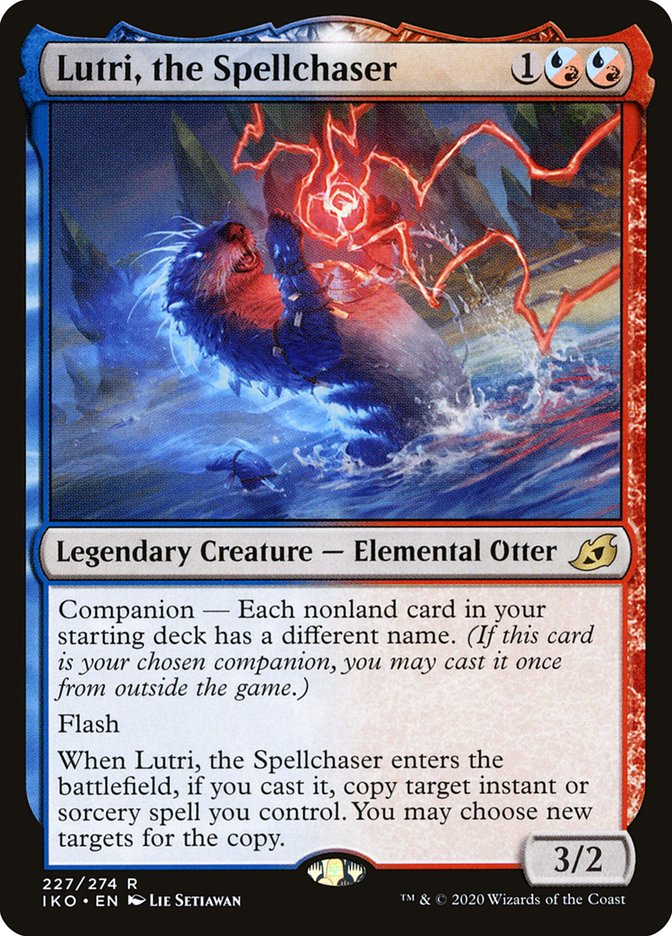
<p>Lutri, the Spellchaser is a unique card when it comes to cube. It is the only “free” card you get in most cubes. (As long as the cube is singleton. (And doesn’t have conspiracies.)) Which makes it a very different card to try and evaluate, in this post I’m not going to answer how good a Dualcaster Mage that can’t combo is. But I will try to provide a framework for evaluating Lutri in a deck, in a mathematical sense.</p>

<p>The framework I’ll be using revolves around <code class="language-plaintext highlighter-rouge">game win probability added</code> this is not a value I will be giving actual numbers for, but it will be used to compare cards abstractly. From now on i will shorten this to just %, so Lutri% is the percentage your winrate improves if you have Lutri.</p>

<p>Now the first thing to consider is the cost of picking Lutri, which is that you’re not picking anything else. Which amounts to replacing whatever card you could’ve picked with the 23rd best card in your final pool. From now on I will be referring to the card you could’ve picked instead of Lutri as the <code class="language-plaintext highlighter-rouge">Missed</code> card, and the 23rd best card in your final pool as the <code class="language-plaintext highlighter-rouge">Replacement</code> card.</p>

<p>When evaluating the power of the missed card, we must compare it to the replacement card. Effectively the power of picking the missed card is <code class="language-plaintext highlighter-rouge">Missed%-Replacement%</code>. Lutri is different, since Lutri is not replacing a card in your deck, it is always an extra piece, so it can just be evaluated as <code class="language-plaintext highlighter-rouge">Lutri%-0</code>. This is the first factor making Lutri strong.</p>

<p>The second is that well, you don’t have to draw Lutri. There will be some amount of games where the Missed card is not drawn. In which case the change in winrate is 0.</p>

<p>The math here is fairly simple, the chance any given card is in the first <code class="language-plaintext highlighter-rouge">X</code> cards you draw is <code class="language-plaintext highlighter-rouge">X/40</code>.
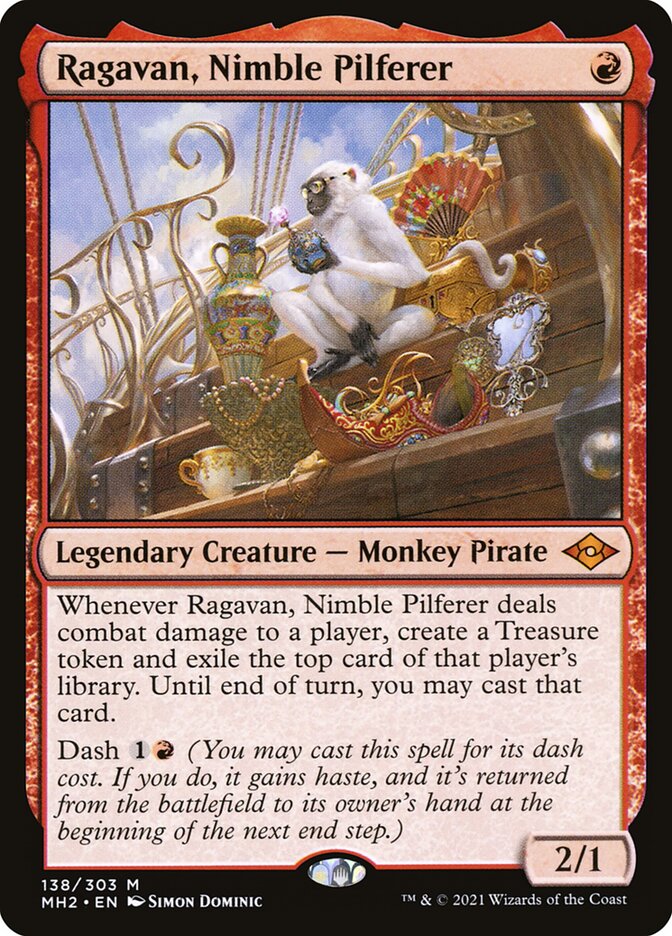
So lets consider a one drop which specifically wants to be drawn on turn one, for an example, consider it to be <a href="https://cards.scryfall.io/large/front/a/9/a9738cda-adb1-47fb-9f4c-ecd930228c4d.jpg?1681963138">Ragavan</a>. On turn one you’ll have drawn 7.5 cards. So the chance you draw Ragavan on turn 1 is <code class="language-plaintext highlighter-rouge">7.5/40~=19%</code>. (This is underestimating, see footnote<sup id="fnref:1" role="doc-noteref"><a href="#fn:1" class="footnote" rel="footnote">1</a></sup>) If we take this at face value, we should ask if Ragavan is not just 5 times as good as Lutri, but if the difference between Ragavan% and Replacement% is 5 times as high as Lutri%.</p>

<p>Now most games, even in vintage cube, are longer than 1 turn. So lets consider a more general case, if we draw <code class="language-plaintext highlighter-rouge">X</code> cards over the course of a game. You divide the WP+% of the Missed card by <code class="language-plaintext highlighter-rouge">40/X</code> to adjust for the chance the card is not drawn. If a card only matter before a certain turn, just pick an <code class="language-plaintext highlighter-rouge">X</code> that excludes any later turns.</p>

<p>So to put it as a formula</p>

<figure class="highlight"><pre><code class="language-xml" data-lang="xml">L = Win chance of Lutri
M = Win chance of the missed card
R = Win chance of the replacement card
# = Number of cards drawn in a game

IF  L &gt; (# * (M-R)/40) THEN [pick Lutri]
ELSE [pick missed card]</code></pre></figure>

<p>Lets do one full example before I end this post. The numbers here will be fully pulled out of my ass, I will leave finding the correct powerlevel to actual good cube players. We’ll be comparing Lutri to <a href="https://cards.scryfall.io/normal/front/b/5/b5e81649-9954-424c-89d1-f87d73b66047.jpg?1595869185">Fatal Push</a>, and our replacement card is what I consider the weakest black removal spell in the current vintage cube, <a href="https://cards.scryfall.io/normal/front/3/5/35f1a6ba-e46f-44fb-93f4-fb883d677b36.jpg?1624590749">Baleful Mastery</a>.
My estimate that Lutri wins you a game you would not otherwise have won at about 1/20, and I expect an random vintage cube deck to draw 15 cards in a game. That makes the math</p>

<figure class="highlight"><pre><code class="language-xml" data-lang="xml">0.05 &gt; (15 * (M-R)/40)
0.05/15 &gt; (M-R)/40`
(0.05/15)*40 &gt; (M-R)
2/15 &gt; M-R</code></pre></figure>

<p>So that comes out to, does Balefull Mastery lose you a game Fatal Push would’ve won 2 out of 15 times it’s in your hand. And well, I do not know. I also don’t know if Lutri’s win rate is actually 1/20. But I hope overall this math can be used by people with better card evaluation skills to pick Lutri at correct times.</p>

<div class="footnotes" role="doc-endnotes">
  <ol>
    <li id="fn:1" role="doc-endnote">
      <p>This assumes mulligans are not important, this is reasonable if you assume Ragavan is not relevant to the chance of a hand being a mulligan. This is false, both in a positive sense, a hand containing Ragavan is more likely to contain 0 lands; and in a negative sense, Ragavan is a really good card and makes opening hands it is in better and thus more likely to be kept. <a href="#fnref:1" class="reversefootnote" role="doc-backlink">&#8617;</a></p>
    </li>
  </ol>
</div>]]></content><author><name></name></author><category term="mtg" /><category term="cube" /><category term="math" /><summary type="html"><![CDATA[]]></summary></entry></feed>