Fair Consulation in Canlander
I’ve been thinking about the canlander points list lately, mostly in regard to the tutors. Most of the good ones are pointed, (ie: everything down to Wishclaw & Tainted Pact) but one notable one isn’t, Demonic Consultation.
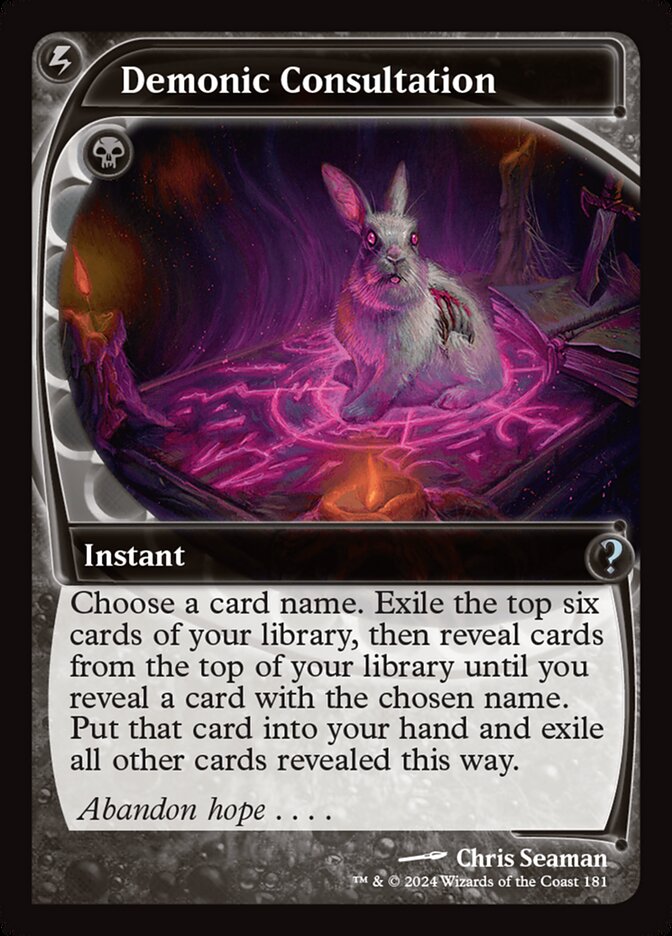
Now I understand why this is, it’s mostly seen as a combo piece with Thassa’s Oracle, which is pointed highly. But is that really the only way to use a 1 mana instant speed tutor? Consultation has been banned in legacy and restricted in vintage since 2000, way before Lab Man came out in 2011. So the card itself must be good, even when it doesn’t just say “Exile your library”.
You might be saying, “of course it’s good there, those aren’t singleton formats” and that’s a very valid point. Playing Consultation fairly in canlander has a ~9% chance of killing you instantly. Which is… bad. But is it that bad? I can think of plenty of times when tutoring the exact card I need swings my win probability by way more than 9%. If there’s a combo on the stack, I’m happy to lose 9% of the time to get a Force of Will the other times. Same the other way around, if I’m tutoring up a combo that wins me the game instantly, I’ll take 9% to lose if I win the other times.
What I’m getting at is, Consultation is a good tutor in high leverage situations, aka in situations where the game ends very soon. If the card you’re getting changes your win probability by more than 9%, then consultation is good1, and combo decks are all about taking calculated risks.
Now the main issue is the card is dead if you’re not in those situations, which is a real downside, but I do believe it is worth playing in combo decks because of its immense efficiency in the good situations.
That was the main body of this post, but I have some idle thoughts I want to add:
- You can significantly reduce the chance of dying if you have some knowledge of your deck, through effects like Brainstorm and Ponder.
- The 9% chance is based on having 85 cards in your library, and the top 6 and bottom 2 cards of the deck being losing hits, leading to a 9.4% chance of death, actual percentages change a lot depending on context.
- Having taken a mulligan without fetching after also lowers the chance of losing slightly, as the bottom card of your deck is now never the card you’re looking for.
- If the game ends up lasting longer than a turn or two, you have to work with a more than 9% lose chance, as more cards on the bottom of your decks become losing hits.
-
Technically this is wrong, the actual probabilities end up being multiplicative rather than the additive system mentioned here, but calculating win probability is abstract enough I think the simplicity is warranted. (It should actually improve your win probability by 9% of the current win probability, so 1% -> 2% is still good enough.) ↩